
The Value of Cemeteries in Family Research
By Becky Aaronson, VP of Education for CCNGS
In the summer of 2000, my mother and I set out on what we thought would be a simple heritage trip to her old stomping grounds in Cattaraugus County, New York.
It became much more.
Limestone — the town of her birth — sits about ninety miles south of Buffalo, pressed close to the Pennsylvania border. Today it’s officially a village within Carrollton, but once it was a bustling place with a tanning mill, lively bars, two churches, and during the roaring 1920s, a convenient stop between Chicago and New York City for bootleggers and mobsters.
(That, as they say, is another story.)
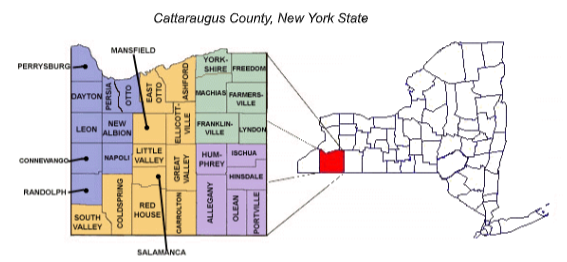
We spent our days visiting relatives on both sides of the family, meeting cousins we hadn’t known existed. But the real discoveries began among the dead.
One afternoon we walked through the small cemetery in Limestone where many of our ancestors are buried. The stones stood quietly in uneven rows, names softened by time and weather. My mother would pause, brush lichen from a date, and suddenly a memory would surface — a story about her industrious mother, a pie-baking grandmother, a long-ago winter. The past seemed to breathe again in those moments. I cherish them even more now, knowing she passed just two years later at age 79.
We also visited Wildwood Cemetery in nearby Salamanca, twelve miles northwest of Limestone, where many of Mom’s “Fee” ancestors are buried. Mom’s grandmother, Mary Diantha Wright, had grown up in Salamanca and married Charles Allen Fee. Salamanca today is small — little more than a hotel and casino operated by the Seneca Nation, as the city lies within the Allegany Territory of the Seneca Nation of Indians. It’s a quiet place, but the cemetery holds generations of stories.
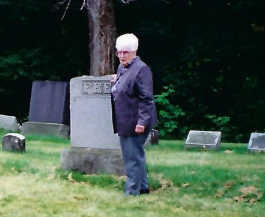
My Mom, Dorothy ‘Dotty’ (Fee) Lamb, standing by her ‘Fee’ ancestors in Wildwood Cemetery
Still, the most extraordinary discovery of the trip came entirely by accident.
Driving between Olean and Limestone, we passed through Allegany, home to St. Bonaventure University — often seen during the college basketball “March Madness.” As we drove through town, I spotted a sign for St. Bonaventure Cemetery.
If you’ve seen the movie Up, you’ll understand what happened next — in my mind: “Squirrel!”
My mother, however, was not amused. “It’s Catholic,” she insisted firmly. “We don’t have any Catholic ancestors. We’ll find nothing there.”
However, genealogy curiosity has always been stronger than caution for me. I turned the car up the hill.
And there it was. A large monument bearing my mother’s maiden name: FEE. Surrounding it were several headstones with the same surname.
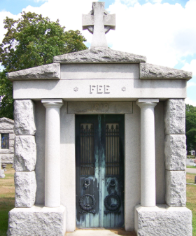
Mom folded her arms. “We’re not related to them.”
“Mom,” I said gently, “this is twelve miles from your hometown. That’s too close not to mean something.”
As luck would have it, the cemetery had a full-time caretaker. When I explained my curiosity about the Fee family, he surprised us by saying we should speak to his mother. She lived nearby and knew the family history.
And so, on a warm summer afternoon, we found ourselves sitting in the living room of Mary Kathleen (Stayer) Vossler — a gracious woman with a sharp memory and a generous heart and a Fee descendant.
Her second great-grandfather, she told us, was Thomas Fee, an Irish immigrant who arrived in the 1840s. Then she leaned in and shared the family legend: Thomas had been a coachman for a titled Englishman — Sir Richard Dawson — in Northern Ireland. Thomas fell in love with Dawson’s daughter, Mary. Such a match was forbidden, so Thomas and Mary fled to America to marry.
Was it true? I can’t say for certain. I’ve since encountered suspiciously similar tales elsewhere. But what was true is that Thomas and Mary did immigrate to America in the 1840s. And that detail caught my attention.
You see, my mother’s great-grandfather, Owen Fee, had also immigrated from Ireland in the 1840s, marrying a local girl of 17, Catherine Marsh. He served as a corporal in the Union Army during the Civil War and died at the Battle of Fair Oaks in June 1862, leaving behind a widow and nine children — the youngest only two weeks old. We knew much about Owen’s life in America, but we knew nothing about his parents, nothing about siblings.
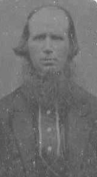
Could Thomas and Owen be connected? My mother still insisted we had no Catholic ancestry and no connection to this Fee family. I wasn’t so sure.
Back home, I turned to the growing wealth of online records. Census after census came into focus. In the 1850 and 1860 U.S. Federal Census, I found Owen Fee — and living next door, Thomas Fee, neighbors. Their children’s names overlapped in curious ways. Patterns emerged. I dug deeper, compared records, and contacted distant relatives. Piece by piece, the puzzle assembled itself.
Thomas and Owen were brothers. I eventually identified what appears to be a younger brother, John, who immigrated later, and likely their mother, Catherine, in local records.
The Catholic cemetery my mother almost refused to visit had revealed her lost Irish branch.
So why had she believed so firmly that we had no Catholic ancestors? Further research offered an explanation. Owen’s son, Charles Fee — my mother’s grandfather — likely left the Catholic Church to marry Mary, a Baptist. Charles died in 1902, long before my mother was born. In time, the family became Methodist — one of Limestone’s two churches, the other Catholic. Meanwhile, Thomas Fee’s descendants remained in that church and eventually moved to Pennsylvania, where his sons built a successful logging business.
Over time, religious differences and geographic distance quietly erased the memory of shared origins. But not entirely. Because on one impulsive detour into a cemetery, we found them again.
That day in Allegany taught me something invaluable: cemeteries are not just resting places for the dead. They are crossroads of memory, faith, migration, heartbreak, and resilience. They hold the stories families forget — until someone curious enough turns up the hill.
And because I did, my mother left this world knowing a fuller story of her Irish roots.
All thanks to a cemetery.
